

Where and when
Camogli (Genoa, Italy) ---- 8-10 June 2026

About the School
Understanding how neural structure The school offers multidisciplinary training on multiscale approaches to the study of neurodevelopmental disorders, starting from the patient and integrating in vitro, in vivo, and computational models. The goal is to show how these different levels contribute to understanding pathological mechanisms and to the development of personalized therapies.
Guiding questions:
• How can we move from the laboratory to the patient?
• How can experimental discoveries be translated into effective therapies?
The school “Bridge the Gap: Multiscale Approaches in Neurodevelopmental Disorders” aims to address the challenges associated with neuropsychiatric and neurological diseases. The program will focus on the design and use of patient-derived models, in vivo platforms, and the growing importance of digital twins to predict personalized therapeutic responses.
Scientific and Educational Relevance
Neurodevelopmental disorders are highly heterogeneous and complex, and current diagnostic tools and therapies often fail to capture patient-specific features or predict treatment outcomes. The school addresses this challenge by introducing an integrated multiscale approach that includes clinical assessments, patient-derived in vitro models, in vivo systems, and computational modeling. The school:
promotes integration across biology, engineering, neuroscience, and computational modeling;
provides skills to connect different levels of analysis, from the neuron to the patient’s brain;
fosters innovation in personalized medicine through experimental technologies and predictive models;
stimulates open discussion on the obstacles that hinder full bench-to-bedside translation.
Educational Program
The course is structured into five thematic sessions:
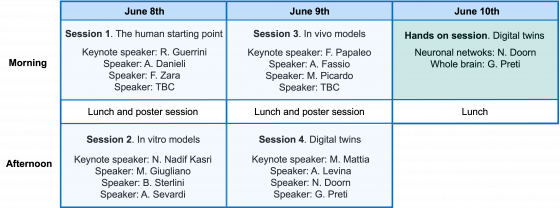
The Human Starting Point: Clinical Practice, Diagnosis, and Open Questions
Introduction to neurodevelopmental disorders, diagnostic tools, and major unresolved challenges.
Personalized In Vitro Models
Neuronal models derived from patient cells to study pathological phenotypes and test personalized therapies.
In Vivo Models
Validation of in vitro findings and investigation of effects on neural circuits and behavior.
Digital Twins: Multiscale Computational Models
Integration of molecular, cellular, and clinical data to simulate pathological dynamics and treatment responses.
Hands-on: Building Digital Twins
Practical activities to develop predictive models of neural networks and the human brain based on real data.
Each session includes keynote lectures, expert talks, and open discussion with participants. This format is designed to train a new generation of researchers and professionals capable of integrating multiple disciplines to address emerging needs in neuroscience.
Program
Program of the school
Speakers
Confirmed speakers:
- Renzo Guerrini - University of Florence (Florence, Italy)
- Federico Zara - IRCCS G. Gaslini (Genoa, Italy)
- Alberto Danieli - IRCCS E. Medea (Verona, Italy)
- Nael Nadif Kasri - RadboudUmc (Nijmegen, the Netherlands)
- Bruno Sterlini - University of Genoa (Genoa, Italy)
- Michele Giugliano - University of Modena and Reggio Emilia (Italy)
- Annalisa Savardi - IAMA Therapeutics (Genoa, Italy)
- Francesco Papaleo - Italian Institute of Technology (Genoa, Italy)
- Michel Picardo - INMED (Marseille, France)
- Anna Fassio - University of Genoa (Genoa, Italy)
- Maurizio Mattia - Sapienza University of Rome (Rome, Italy)
- Anna Levina - University of Tuebingen (Tuebingen, Germany)
- Giacomo Preti - Aix-Marseille University (Marseille, France)
- Nina Doorn - University of Twente (the Netherlands)
Poster awards
We are pleased to announce the call for poster submissions for the Best Poster Presentation Awards.
Posters will be evaluated by the scientific committee based on scientific quality, originality, clarity, and relevance to the themes of the School.
Awardees will be announced at the end of the School.
Organizers
Neuroengineering Genoa Group @DIBRIS
https://neuroengineering.unige.it/
Prof. Monica Frega
Prof. Gabriele Arnulfo
Sponsors
This School is made possible thanks to the support of our institutional and scientific partners.
Institutional Sponsors:
University of Genoa
Department of Informatics, Bioengineering, Robotics, and Systems Engineering (DIBRIS), University of Genoa
Scientific & Technical Partners:
IEEE EMBS
3Brain
Corticale